
Guides · Planning
Hybrid, grid-tied or off-grid: which solar system do you need?
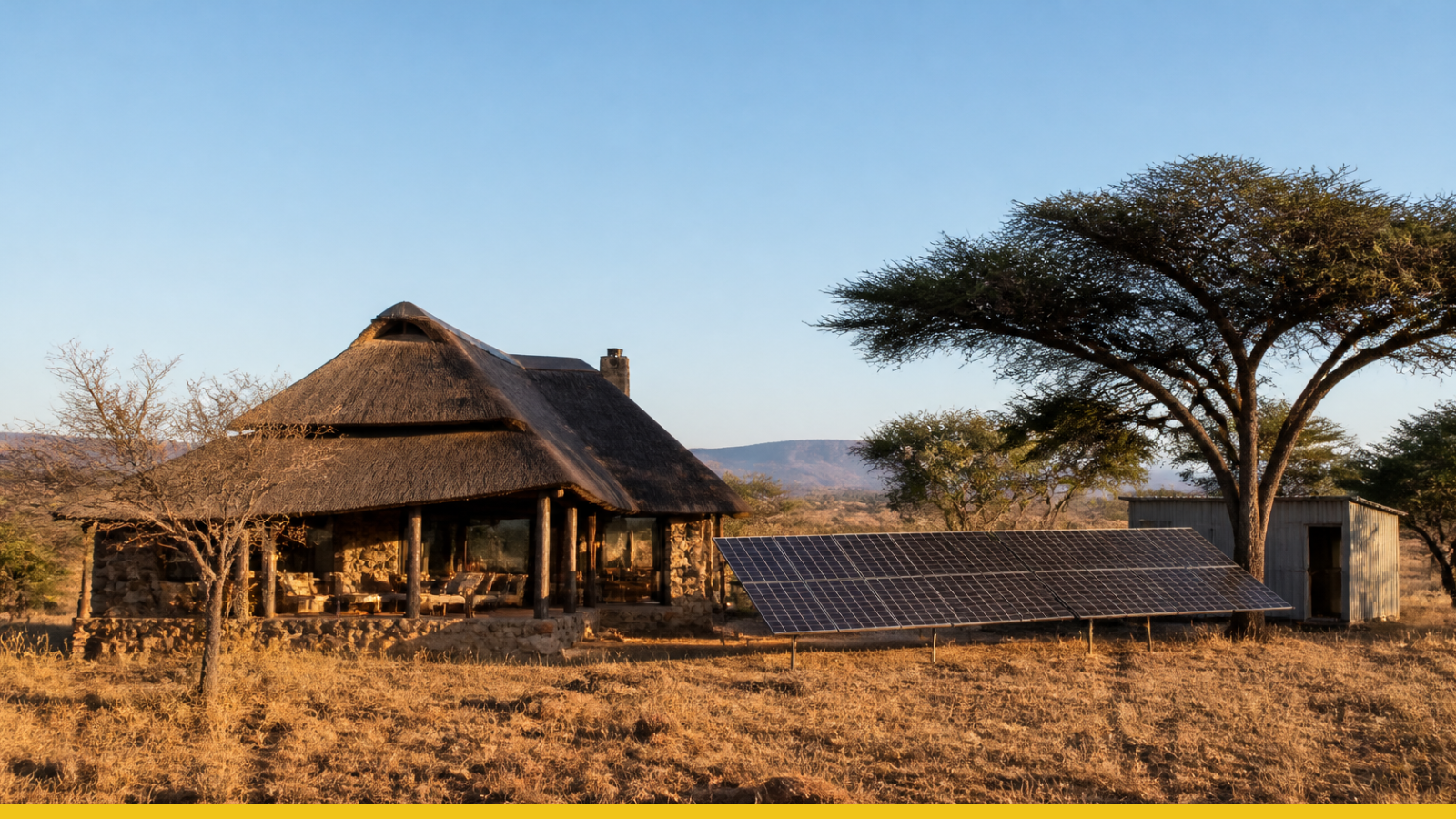
Short answer: A grid-tied system has panels but no battery, cuts your daytime bill and switches off when the grid goes down. A hybrid system adds a battery, so it saves money and keeps the essentials running in an outage. An off-grid system has no grid connection at all and costs far more, so it suits farms, lodges and remote sites. Most suburban homes choose hybrid.
Last updated November 2026.
"Off-grid" is one of the most searched solar terms in South Africa, but most people who search for it don't actually want to cut the cable to Eskom or the municipality. They want lower bills and no more sitting in the dark. Those are different goals, and they lead to different systems at very different prices. This guide explains the three types of solar installation in plain English, what each one costs, and which one fits a suburban home, a business or a farm.
What is the difference between hybrid, grid-tied and off-grid solar?
The difference comes down to two questions: is there a battery, and is the system connected to the grid?
| Grid-tied | Hybrid | Off-grid | |
|---|---|---|---|
| Battery | No | Yes | Yes, and a large one |
| Connected to the grid | Yes | Yes | No |
| Power during an outage | No. It switches off with the grid | Yes, for the circuits on backup | There is no grid to lose |
| Cuts your bill | Daytime only | Day and evening | No bill, but you carry every cost yourself |
| Registration with your municipality or Eskom | Required | Required | Exempt, if there is truly no connection |
| Relative cost | Lowest | Middle | Highest, often two to three times a hybrid |
| Best for | Businesses and homes that use most power in daylight | Most suburban homes, and farms with a grid connection | Farms, lodges, boreholes and sites far from a grid line |
How does a grid-tied system work?
Power flow: panels → inverter → your distribution board, with the grid filling any gap.
The panels feed an inverter, which turns their DC power into the AC power your house uses. While the sun is up, your appliances use solar first and draw the rest from the grid. If you produce more than you use, the extra can be exported. City Power, for example, credits registered customers for exported units, though at a much lower rate than you pay to buy them.
The catch is outages. A grid-tied inverter must shut down when the grid fails, so it never pushes power into lines that technicians think are dead. That means a grid-tied system gives you nothing during an outage, even on a sunny day.
Grid-tied is the cheapest way to cut a bill, because the battery is usually the most expensive part of any system. It suits shops, offices, factories and warehouses that use most of their power in daylight, which is why it's the usual starting point for commercial solar. My guide to solar for warehouses and factories goes into the numbers.
How does a hybrid system work?
Power flow: panels → hybrid inverter → your house, with the battery charging from surplus solar and the grid as a backstop.
A hybrid inverter manages three sources at once: the panels, a battery and the grid. During the day the panels run the house and charge the battery. In the evening the battery takes over, which is when Joburg homes use the most power. If the grid goes down, the inverter disconnects from it and keeps the circuits on backup running from the panels and battery.
This is where most two- and three-bedroom suburban homes land, at roughly R90,000 to R145,000 installed. My guide to what solar costs in 2026 breaks that down. The battery also lets you move cheap daytime solar into the expensive evening hours. See load shifting for how to set it up.
A hybrid system is still connected to the grid, so it still has to be registered, even if it's set never to export a single unit. NERSA confirmed in February 2026 that registration depends on whether a system has a point of connection to the grid, not on whether it exports. In Johannesburg, registering usually means moving to a postpaid account with a higher fixed monthly charge. My guide to SSEG registration in Johannesburg works through those numbers.
How does an off-grid system work?
Power flow: panels → off-grid inverter → battery bank and your loads, usually with a generator as the backstop.
An off-grid system has no connection to Eskom or the municipality. Everything you use has to come from the panels, the battery or a generator. That changes how it has to be designed. The system must carry you through several grey winter days in a row, not just one evening, so the battery bank is much bigger, the array is larger, and most designs still include a generator for long cloudy spells.
That is why off-grid costs so much more. One South African price guide, updated in October 2026, put a fully off-grid three-bedroom home at about R250,000 to R350,000, with the battery bank making up 40 to 50% of the cost. A hybrid system for the same house costs a fraction of that, because the grid covers the rare bad week.
Off-grid systems with no point of connection are exempt from SSEG registration. Eskom has said owners may need to show that the system really is independent of its supply. Off-grid is still an electrical installation, though, so it must be installed by a registered person and covered by a Certificate of Compliance. See what a CoC does and doesn't mean.
Which system do you need?
| Your situation | Usually the right fit |
|---|---|
| Suburban home, want a lower bill and backup in outages | Hybrid |
| Home with someone in all day and a tight budget, outages not a big worry | Grid-tied , with a hybrid inverter so a battery can be added later |
| Business open mainly in daylight | Grid-tied , adding batteries only where downtime is costly |
| Farm with an Eskom connection | Hybrid , keeping the generator as backup |
| Remote borehole, camp, lodge or outbuilding far from a grid line | Off-grid |
When does off-grid make sense on a farm or lodge?
Off-grid earns its cost where the grid is far away, unreliable or expensive to extend. A new connection to a remote camp, pump or workshop can cost more than an off-grid system, and take far longer. Remote sites that now run on a generator are the other strong case. Diesel went from about R19 to almost R32 a litre inland in the year to October 2026, so every hour of generator time cut matters. My guide to solar for game lodges and bush camps covers lodge loads, batteries and the generator in detail.
Boreholes are a special case. A solar pump can run with no battery at all if it pumps into a tank or reservoir during the day, so you store water instead of electricity. That is usually the cheapest off-grid system on a farm.
For the farmhouse and sheds, hybrid is usually the better fit where Eskom is already connected. It cuts the bill and the diesel, and the grid covers the long cloudy spells instead of a battery bank sized for the worst week of winter. My guide to solar for farms covers pumps, cold rooms and theft, and the farm solar page explains what to send for a quote.
Can you go fully off-grid in a city home?
Technically, yes. In practice it rarely makes sense. You would need a system sized for winter rather than summer, a battery bank that costs more than most hybrid systems, and probably a generator. And the city doesn't always let you leave: Tshwane, for one, has said it won't allow connected homes to go off-grid. If the goal is a lower bill and no more outages, a well-sized hybrid system gets you most of the way for a fraction of the cost.
Safety First
- Never connect a generator or inverter to your house wiring without a proper changeover switch. Backfeeding a dead grid line can kill the person working on it.
- Solar panels make DC power whenever there is daylight. Switching off the inverter does not make the roof cables safe.
- Off-grid doesn't mean off the books. It still needs a registered electrician and a CoC, and your insurer still needs to know.
Frequently Asked Questions
Does grid-tied solar work during outages?
No. A grid-tied inverter is required to shut down when the grid fails, so it can't feed power into lines that technicians think are off. You need a battery and a hybrid inverter for backup.
Can I add a battery later?
Yes, if the system was planned for it. The easiest way is to install a hybrid inverter from the start and add the battery when you're ready. A plain grid-tied inverter usually needs a second, battery inverter or a replacement. My guide to adding panels or a battery explains the options.
Do I have to register a hybrid system if it never exports?
Yes. NERSA's February 2026 clarification says registration depends on whether the system has a point of connection to the grid, not on whether it exports. Only systems with no connection at all are exempt.
Can I go fully off-grid in a city home?
It's possible but expensive, because the system has to cover the worst week of winter on its own. Some municipalities resist it too. For most city homes, hybrid is the better value.
When does off-grid make sense on a farm?
When the site is far from a grid line, when extending the grid would be costly or slow, or when a generator is doing most of the work today. Boreholes pumping into a tank are often the cheapest place to start.
Where I fit in
I plan and manage solar for businesses and farms. I start with your bills and how you really use power, then bring in a registered installer working to the CleanVolts Approved standard, who designs, installs and signs off the system under their own registration. You contract with them directly, and I stay your point of contact. If the installer pays me a referral fee, I tell you before you sign.
Sources: NERSA clarifies registration requirements for SSEG, 2 February 2026; BusinessTech, 12 February 2025: Eskom on off-grid systems; EnergyBee, updated 11 October 2026: the cost of going off-grid.
I've stopped adding new guides. For anything not covered here, ask my assistant and I'll answer you directly.