
Guides · Existing systems
What a Solar Health Check includes (and what it doesn't)
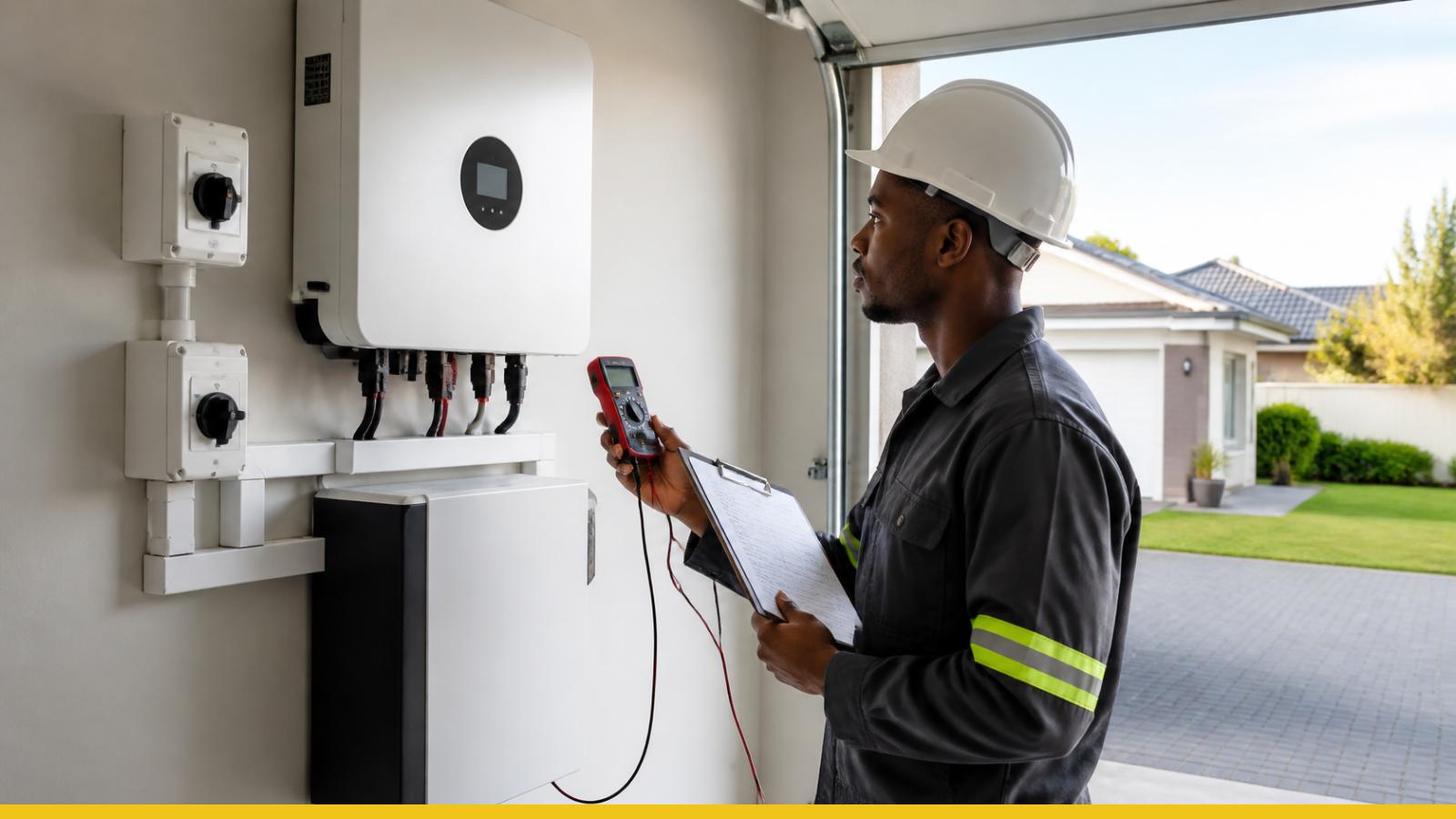
Short answer: A Solar Health Check is about two hours on site looking at your panels, inverter, battery, settings, protection and paperwork, then a written report with photos. It is a covers-on inspection, not a full audit: no thermal survey, string testing or repairs. It shows whether your system is safe, performing and documented, and what to fix first.
Last updated October 2026.
Most home solar systems in Joburg went in quickly during load shedding, and many have not been looked at since. The panels keep producing something, the app shows numbers, and it is hard to know whether those numbers are good. If you want an independent view, you can book a Solar Health Check. This guide explains exactly what happens on the visit, what the report covers, what the check does not do, and how it compares with a full audit, so you know what you are paying for before anyone arrives.
What does a solar health check include?
The check has five parts. Everything is done without opening equipment or taking anything apart.
| Part of the check | What is looked at | What it tells you |
|---|---|---|
| Panels and roof | Panels viewed from the ground, a ladder or the roof: cracks, soiling, shading, bird nesting, loose or corroded mounting, cable runs | Whether anything visible is damaging output or creating a risk |
| Inverter, battery and boards | Inverter, battery, DC and AC isolators and the DB board with covers on: labelling, ventilation, signs of heat, surge protection indicators, earth leakage test buttons | Whether the installation looks safe and is protected |
| Electrical readings | Safe, non-intrusive measurements only | Whether the system is behaving the way the data says it is |
| Data and settings | Your inverter and monitoring data compared with what a system of that size should produce; alarm history; battery and grid settings | Whether you are getting the output you paid for, and whether settings still suit how you use power |
| Paperwork | Certificate of Compliance (CoC), City Power SSEG registration, and whether your insurer knows about the system | Whether the system is legal, insurable and ready for a future sale |
The visit also covers the system's history and your concerns. If the inverter trips every afternoon or the battery is flat before sunrise, say so up front so the check can focus there.
What does the visit look like, step by step?
- Before the visit. You get the name of the partner and who is coming. Secure dogs, clear access to the DB board, inverter and battery, and have your CoC, the installer's invoice, any SSEG letter and your monitoring app login ready.
- Your history and concerns. A short conversation about when the system went in, what has changed since and what is bothering you.
- Data review. The alarm log and production history are checked first, because they point to where to look.
- Equipment and boards. A covers-on inspection of the inverter, battery, isolators and DB board, with safe readings and photographs.
- Panels and roof. A look at the array from the safest available position.
- Paperwork. Your documents are checked against what is installed.
The whole visit takes about two hours. Nothing is dismantled, repaired or certified on the day.
What is in the written report?
The report arrives within three working days. It is no more than six pages, with photographs, and is followed by a 20-minute call to talk it through. Every finding is ranked so you know what matters most:
| Ranking | What it means | Example of the kind of finding |
|---|---|---|
| Immediate | A safety risk. Act now. | Scorch marks on a connection, or an earth leakage unit that does not trip when tested |
| Important | Affects performance, legality or insurance. Plan to fix soon. | No CoC covering the solar work, or a surge protection device showing it needs replacing |
| Advisory | Worth doing, but not urgent. | Settings still set for load shedding, or panels due for a clean |
The examples above show the kind of finding each ranking covers. Your report lists what was actually found on your system.
What does a health check not include?
A health check is designed to be quick and affordable, so some things are left out on purpose:
- No thermal survey. Hot connections that only show up under a thermal camera are not looked for.
- No string tests. The panel strings are not tested one by one on the DC side.
- No roof structural check. Whether the roof can carry the panels is not assessed.
- No repairs. Nothing is fixed, adjusted or dismantled during the visit.
- No CoC. Only a registered person (an electrical tester for single phase, an installation electrician or a master installation electrician) can issue a CoC, and only after inspecting and testing the installation. A health check is not that inspection.
If the check finds something that needs those deeper tests, the report says so.
How is a health check different from a full audit?
| Solar Health Check | Full Solar System Audit | |
|---|---|---|
| Time on site | About two hours | Four to six hours |
| Scope | Covers-on inspection, data review, safe readings, paperwork | Adds a thermal scan under load, string-by-string DC tests, and closer earthing, bonding and labelling checks |
| Best for | A system that has never been checked, a fault you are unsure about, or knowing where you stand | Selling the property, an insurer asking for proof, or a known fault that needs a report you can share |
| What you get | A written report with ranked findings | A written report plus a scope of work any registered electrical contractor can quote against |
If you are buying or selling a house, or your insurer has asked for evidence, the Full Solar System Audit is usually the better fit. My guide to selling a house with solar in Johannesburg explains the paperwork conveyancers ask for.
When should you book a health check?
- Your system has never been checked since it was installed.
- Your installer has closed or stopped answering. See who services your system now.
- Output seems lower than it used to be. My guide to checking whether your solar system is underperforming covers the checks you can do from the app first.
- The inverter keeps tripping or showing alarms. Start with the common causes of tripping.
- You have had a hailstorm or a close lightning strike. See hail damage on solar panels and surge protection for solar.
- You are not sure whether you have a CoC or whether the system is registered.
Why does the paperwork part matter?
Under the Electrical Installation Regulations, the owner or user of a property is responsible for the safety, safe use and maintenance of its electrical installation, and must hold a valid CoC. When solar is added, the addition needs a CoC. My guide to your legal duty as a solar system owner explains what that means in practice.
City Power also requires grid-connected systems to be registered as small-scale embedded generators (SSEG). The process and its effect on your account were under discussion between City Power and the solar industry during 2026, so check the current position. My guide to SSEG registration in Johannesburg has the details. A missing CoC or unregistered system is one of the most common findings, and one of the easiest to sort out once you know. If you have no CoC, read what to do when there is no CoC.
Safety First
- Don't open the inverter, battery, DB board or any combiner box before the visit. Solar DC circuits stay live in daylight even when the inverter is switched off.
- If you smell burning, see scorch marks or hear crackling, don't wait for a health check. Switch nothing back on and get a registered electrical contractor out.
- Don't climb onto the roof to look at the panels yourself. A photo from the ground or an upstairs window is enough for the conversation.
Frequently Asked Questions
How long does a solar health check take?
About two hours on site for a typical home system. The written report follows within three working days, and a 20-minute call walks you through it.
How often should I have one?
Once a year is a sensible rhythm for most home systems, and sooner after a major hailstorm, a close lightning strike or any change to the system. A system that has never been checked since installation should be checked first.
What happens if you find a problem?
The report ranks it as Immediate, Important or Advisory and explains what it will take to fix. There is no obligation to use anyone in particular. If you want the work done, a registered installer working to the CleanVolts Approved standard can quote, and you contract them directly.
What does a solar health check cost?
The price depends on your system and is confirmed before anyone visits. A health check costs less than a full audit because it is shorter and does not include thermal or string testing.
How I Can Help
These days I focus on solar for businesses and farms. If you're a homeowner, I'll gladly introduce you to a registered installer working to the CleanVolts Approved standard, who will carry out your Solar Health Check. The installer contracts with you directly and signs off the work. Using CleanVolts costs you nothing, and if the installer pays me a referral fee, I'll tell you up front.
Book a Health Check · Free checklist: is your solar legal and safe?
_Sources: Electrical Installation Regulations, 2009 (regulations 2, 7 and 9); Engineering News, 16 April 2026: SAPVIA and City Power on solar registration._
Where I fit in
I plan and manage solar for businesses and farms. I start with your bills and how you really use power, then bring in a registered installer working to the CleanVolts Approved standard, who designs, installs and signs off the system under their own registration. You contract with them directly, and I stay your point of contact. If the installer pays me a referral fee, I tell you before you sign.
I've stopped adding new guides. For anything not covered here, ask my assistant and I'll answer you directly.